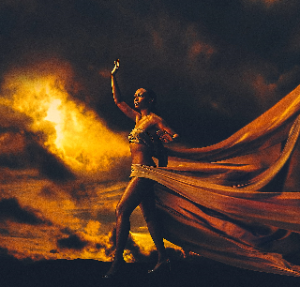
Much of her practice explores the simplified human form, focussing on the subtle nuances of human interaction and body language.
Alongside these works, she creates large-scale, expressive, sand paintings of animals.
Abigail’s interest in the arts began at an early age leading her to study photography at the University of Derby.
“During my degree, I became increasingly aware of the power of imagery and more specifically how it could unlock hidden thoughts and emotions. In my final year I began to explore it further.
“It wasn’t only the act of viewing photos, for me, it was taking the photographs, processing them and watching the images emerge which was where the therapeutic value lay – back then it was dark room photography.
“I enjoyed being in my own space in the dark room, and fully immersed in the act of processing the films and developing the photos,” she recalls.
“I started going to the library and researching what there was available to highlight the therapeutic aspect of photography and I came across something called phototherapy, which was founded by photographers Jo Spence and Rosy Martin.
“They used photography to navigate identity and personal history, which left a lasting impression on me.
“I contacted Rosy Martin and she agreed to go to my university to give a talk about phototherapy which deepened my interest further and I knew that it was very much something I wanted to develop my understanding of.
“I didn’t want to train as a therapist, that wasn’t the area I wanted to go into but the benefits of photography were just incredible, there was so much to it.
“When she came to the university we spent time talking through different things you could do with photography and I liked the idea of revisiting my past via photographs.
“I subsequently began a project where I used cine films from my childhood projected onto the wall behind me and then I re-enacted certain events and photographed myself in front of the projection.
“It was looking at relationships from my past, especially the interactions and recreating certain moments from the films by adding myself as an adult that fascinated me,” says Abigail.
After graduating in 2001, she had various jobs, which didn’t leave her time to think any more about what she had studied.
Then, in 2005, Abigail was in Sharm El-Sheikh at the same time as a string of bomb attacks were launched outside two hotels and a market.
“That was a traumatic experience for me and when I came back, a reporter and a photographer from the Shropshire Star came to talk to me.
“I was looking for a new job and the photographer said ‘why don’t you come work for the Shropshire Star as a photographer’ so I did. I was able to use my skills and that started my whole creative journey off again,” she explains.
Abigail went on to work for a leading publishing company that specialises in motoring books.
“I worked there for 20 years as design and media manager and helped deliver publishing and website projects which included working with high-profile figures in Motorsport, such as Murray Walker OBE and Sir Stirling Moss. I built and ran Sir Stirling’s website for a number of years, as part of my role.”
At the back of her mind, however, was a yearning to develop her creativity further.
“I loved working there and it honed my visual discipline and professional eye, but I wanted to still develop this idea of visual imagery being a way of expressing myself therapeutically.
“So, alongside working for that company, I was also painting.
“I knew I wanted to take body language, human connection and memory and explore the theme on canvas. I wanted to introduce a more sensory dimension to my work. An immersive, reflective experience was important to me in creating the work but also for those viewing it. I mentally revisited the feeling of being on a sandy beach – the sand, the smell of the air and the visuals combined.
“But, I’d also looked at the symbolism of sand and how Tibetan monks use it when they create mandalas. They will spend days creating these intricate, detailed diagrams and at the end they will sweep the mandalas away. For them that was signifying the impermanence of life.
“I aimed to do the opposite – I would capture it and create a moment in time. I wanted to create what looked like a slab of rock and to encapsulate my figures in the earthy space.
“Sand symbolises time, fleeting moments, vulnerability and so much more. My figures wouldn’t exist without the sand, they are completely integral to one another. The textures and structure are really important.”
Abigail, aged 47, uses a rich warm colour palette and plays with shadows and lighting in her paintings.
“I think the lighting effects in my paintings have been inspired by my degree in photography where I would play with the studio lights to heighten drama and emotional intensity,” she says.
Abigail continued to paint her sand people during evenings and weekends alongside her full-time job while also exhibiting her work in boutique hotels around the Ludlow area. Unfortunately, in 2014, Abigail suffered a setback when 18 of her large paintings were stolen.
“At that point, I completely stopped painting. I just didn’t want to touch a paintbrush. It was an upsetting experience,” the 47-year-old recalls.
“Over a period of time, my partner had said ‘it’s what makes you happy, you’ve got to paint’.
“So, I started to and when it came back that creative flow just didn’t stop. I managed to build my collection back up and I had a stronger sense of direction and purpose. I was still loving my full-time job but I always knew I wanted to have a studio and gallery.
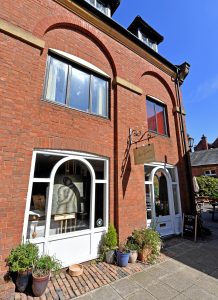
“I didn’t think it would ever be possible but then three years ago, I became quite unwell and when I recovered I thought ‘now is the time to do this’. So I took on the space in Quality Square in Ludlow. I display my work and I create there as well.
“When visitors come in I’m often painting, so it becomes a shared creative experience, rather than a traditional gallery setting.
“It’s inspiring for me and the visitors. It gives them the opportunity to connect with the work. It’s been fantastic to have this space.”
Alongside the sand, Abigail uses acrylic paints for her mixed media work. “Although sand has been used in art for centuries, this process is something I have developed over a period of time. It’s very much a process that has evolved with me.
“Each painting takes roughly a month to create. I begin with a certain pose and gradually refine it as I go. As my emotions shift throughout the process, the pose evolves to reflect this,” she says. After opening the gallery, Abigail, who has exhibited and attended art fairs around the country, started painting animals.
“My animals are very different in style to the people,” she says. “There is a real juxtaposition between them.
“The people are featureless figures and they explore the human experience. By removing the features, you focus on the emotion and the shared vulnerability. But the animals have raw, expressive features that really define them.
“They stem from life’s primal essence but they are fundamentally about the exploration of our hidden depths and how we perceive the world and our identities.
“Although both the people and animals are textured, the animals’ features tend to be quite 3D. Sometimes the head or other features will stand out a bit more. The lighting still tends to be quite dramatic as with the human figures. For me it’s an additional artistic challenge to paint the animals,” she explains.
Abigail enjoys talking to visitors in the gallery about her work and says it’s interesting to hear their interpretations.
“It’s great seeing the reactions when people come in because they will often either get the people, or the animals.
“It’s fun to have a conversation about which they prefer and what they feel when they see them.
“I’ve had some quite emotional reactions from people when they view certain figure poses.
“It’s not every painting that people will get but certain ones may resonate. It’s not just about me creating the images, it’s the person viewing the work that will complete the story.
“I work closely with collectors to create bespoke pieces for their spaces either of the figure paintings or the animals. I love the creative journeys that I go on with my commissions. They very much become fun collaborative projects, with pieces having been sent to many countries.”
As her practice continues to evolve, an exciting programme of exhibitions and art fairs lie ahead. Alongside this, her Ludlow studio and gallery remain an important space to encounter the work up close, offering a direct connection to her latest pieces.
See www.abigailhumphriesart.com or www.instagram.com/abigail_art_