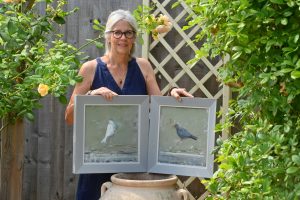
Now a full-time artist with a studio in Waters Upton, her work is held in collections across the globe and one of her paintings, Coach House Hollyhocks, was shortlisted for the British Contemporary Art Award 2026.
Recalling the moment her passion for painting was ignited, she says: “In 2013 I spent a few weeks in France, at an old Charentais farmhouse owned by a photographer friend.
“At the time, I was a little lost, having completed careers in both the financial and charitable sectors, and was uncertain as to what might come next.
“I’d always had a creative streak, having previously run a sideline in calligraphy, designing and handwriting bespoke wedding invitations.
“The trip stirred something in me and, feeling restless I picked up some old paints and using a postcard as a reference image, I created a painting – the first since school days.
“The following day, a friend came over for coffee and, unaware of my creative efforts, admired the painting, asking where I’d bought it. I continued painting and a year later sold my first piece at a local exhibition.”
Her early work was created using acrylic paints before she later switched to oils.
“For the first couple of years, I used acrylic paints, but I found that they dried too quickly for the way that I worked.
“I knew that I needed help to facilitate a change to oils, because of the technicalities involved like the ‘fat over lean’ rule, so I attended two classes at The Gateway, Shrewsbury which proved a useful introduction.
“By now, I had started to sell my work online through ARTFINDER and through them, connected with more experienced artists, who were generous in sharing their knowledge with me.
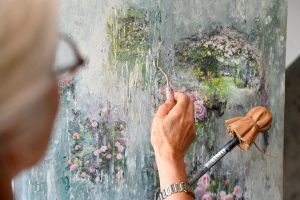
“Today, I use Michael Harding Oils, Rosemary & Co ivory brushes and a series of palette knives. I rarely use colours straight from the tubes, preferring to mix my own, keeping a little notebook of the different mixes so that I can match them another time.
“A few years ago, I stopped using titanium white in favour of warm white, this softens the colours creating the evocative atmosphere my work is known for.”
Rebecca works from her own photographs, her imagination, and from still life arrangements that she sets up in her studio.
Explaining her process, she says: “I use stretched canvas because I like the springiness, but I also prefer a smooth surface, so I apply several coats of acrylic primer, coloured according to what I intend to paint,” she explains.
“Sometimes, I will draw a pencil grid, dividing the canvas into thirds horizontally and vertically. This helps with creating a balanced composition and I may draw a sketch but more often I start with loose brush work outlining objects and blocking in the darkest and lightest areas.
“But I am far more comfortable with a knife in my hand! I have a favourite palette knife, and the painting evolves over several layers, sometimes working ‘wet into wet’ and others allowing paint to dry before the next layer is applied.
“Working this way leaves a smidgeon of texture which helps to bring a contemporary vibe to traditional subject matter. I work in my studio at my home in Waters Upton, it’s a great space with a lovely view of the village church next door.”
“The last two summers, I was fortunate enough to return to the farmhouse in France, where I painted en-plein air, capturing the graceful roses against crumbling honey-coloured walls and soaring spears of hollyhocks against pure blue skies,” she adds.
Keen to develop her own style, Rebecca says it was a deliberate decision to avoid any formal training.
“Consequently, I don’t think it fits neatly into any particular ‘ism’,” she explains. “I started out as a still-life artist, enjoying creating the distinct form of carefully selected objects. I progressed to room interiors, trying to capture the French vibe which had left its own indelible impression on me.
“But it is the background of paintings – or ‘walls’ as I like to refer to them – that are just as important, perhaps more so, as they are witnesses to time.
“Here the painting is more impressionistic, with glimpses of faded wallpaper, crumbling plaster or light falling on the soft folds of drapes framing a window. I am drawn to the work of Bertha Morisot and Joaquín Sorolla’s Painted Gardens.
“Over time, my painting has become freer, losing the tightness of my early work, certainly more expressive, perhaps verging on the semi-abstract.
“Without doubt, there was something about that early trip to France which shifted something in me which I couldn’t articulate in words, but subsequently tried to express through the medium of paint on canvas, always unsatisfactorily which kept me trying, kept me painting.
“Then, some years ago, a wise artist friend commented ‘you don’t paint still life, you paint absent life.’ It was a lightbulb moment, that was exactly it!
“I was painting the absence of something or someone – my Mum who had owned the blue and white jug or the lost love who had given me the poetry book – but also an absence I carry within.
“What, I’m still not sure but it’s trying to find expression, even in the title and subject matter of my debut novel ABSENT LIVES.”
Over time Rebecca’s artistic style has evolved and she has learned when to know a painting is complete and put down her brush.
“It has loosened. I had to work hard to achieve this, I’m naturally quite a neat person and I found it surprisingly difficult to let go of the desire to paint tidily.
“One of the trickiest aspects of painting is knowing when to stop, accepting it’s finished because, as any artist will tell you, it never is! You must make the decision to stop.
“Last summer I began work on a new series called An English Country Garden; these are mixed-media pieces using acrylic, paper collage and oil.
“The collage gets mostly covered with oil, leaving just glimpses of the underlying layers.
“They’re far more expressive than my other work, and yet incorporate some fine details too. I love painting them and I’m really happy with the results.”
Being an artist isn’t always as glamorous as some people might believe, says Rebecca.
“Often it isn’t that enjoyable – standing for hours on a hard floor with the window open for ventilation in the winter, or on days when it just isn’t happening.
“But you keep going, or sometimes accept that the day is a write off and turn up again the next day. You keep going for those times when it does go right, when you are so absorbed, so ‘in the zone’ that time passes unnoticed.
“I guess this is no different to people who chose a dangerous sport because they love the high it gives them. I just get mine in a different, and quite solitary way!
“The other part of the equation is when someone falls in love with your work, when they part with their hard-earned cash to have your painting in their home.
“Earlier this year, I received a message from an eighteen-year-old from Arizona who wanted me to reserve a painting that his girlfriend had seen online. Two months later, when he’d saved up enough money, he bought it and surprised his girlfriend on their one-year anniversary.
“Another collector has bought nine of my paintings over the years and another from the US has seven. It’s a wonderful feeling knowing that something that I created has made its way to Australia or Canada, and even Uzbekistan!”
Rebecca, who has been represented by galleries in the past, sells her work online through her website and her Artfinder shop.
“Locally, I have taken part in Shropshire Art Society exhibitions in Shrewsbury and the Ellesmere College National Art Exhibition.
“I also participate in the Secret Artist Sale, held every other year and hosted by the Soden Collection, Shrewsbury. Apart from a couple of commissions, I have taken a 12-month break from painting while I was concentrating on the publication of my debut novel.
“Now, I am picking up my trusty palette knife again and will be seeking opportunities to exhibit.”
The artist is also very happy to welcome people to The Stackyard Studio to view paintings or to discuss a commission.
“You may have treasured items that you’d like painted as a still-life, or a favourite view. Just contact me to arrange a convenient time,” says Rebecca.
For more information, visit rebeccapells.co.uk or follow Rebecca on Instagram: rebeccapells_artist_author Her debut novel ABSENT LIVES is available through bookshops or Amazon.