The service has now been running in the county for 50 years. The talking newspapers are delivered on memory sticks, broadcast over the internet and made available as podcasts.
Shropshire’s talking newspapers date back to 1975 when county councillor Philip Donnellan met Tony Banyard, a blind resident from Hilton, near Bridgnorth,
Tony had heard about a similar scheme elsewhere and felt it could be beneficial. A public meeting to get the ball rolling was called and it took place at Shrewsbury Castle.
“The ball rolled very hard,” says Mary Pascoe, chairman of West Shropshire Talking Newspaper.
“Lots of local organisations got involved and the council also got involved which was crucial because the council knew the people that would benefit from the service and could explain to them what it was about,” she adds. More than £5,000 was raised through grants and raffles to cover the start-up costs, including purchasing recording equipment and cassette tapes.
“Without the cassette, the talking newspaper wouldn’t have come about because it was a small and easily portable recording device you could send out in the post,” explains Mary.
The first Talking Newspaper in Shropshire was produced in May 1976 at premises in St Mary’s Street, Shrewsbury.
“The premises were on the top floor of a building and the room had been used for hospital radio – that was a bit of serendipity,” says Mary.
“We still have the very first recording. In the excitement of getting the newspaper out, people wouldn’t necessarily have been thinking about archiving it – but they did and we are very fortunate,” she adds. To begin with, the newspaper was produced once a month and had 500 listeners.
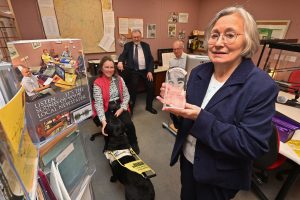
“By Christmas, they were recording once a fortnight. The tapes always started with the sound of bells,” says Mary.
In 1990, it was decided that, due to the size of the county, and the expanding listenership, a better service could be provided by splitting the operation into two using the SY and TF postcodes.
Today, the West Shropshire Talking Newspaper (WSTN) covers the west side of the county, including Shrewsbury, and at the same time, East Shropshire Talking Newspaper (ESTN) covers the east side from Market Drayton in the north to Highley in the south.
The WSTN began being produced weekly in 1991. The first fortnightly East Shropshire Talking Newspaper was produced in May 1990 and from August 1992, it became a weekly operation. Both newspapers are still going strong today.
Since 1996, the WSTN has been based at the Roy Fletcher Centre in Cross Hill, Shrewsbury, having moved in as one of the original tenants. A big change came in 2008 when the team made the move to digital recording, replacing their trusty cassettes with memory sticks.
“Cassettes were becoming old tech and being able to get hold of an inexpensive tape player was difficult,” says Mary, who has volunteered for 22 years.
“We were early in making the transition to memory sticks as we missed the step that other talking newspapers made when they moved from cassettes to CDs. Some still produce on CDs,” says vice-chair Steve Bristow, who has volunteered for 26 years.
The move to digital recording made editing easier and allowed more flexibility because they were limited on time by a 90-minute cassette.
The team publishes a weekly recording based on the Shropshire Star and a monthly digest of Shropshire Magazine. Trustee Lottie Clark, who is registered blind and writes items for the talking newspaper, discovered another benefit as it allowed her to tell one of her stories even though she couldn’t read it aloud.
One of the volunteers spoke the line and then Lottie would repeat it until they had finished the entire piece. In the editing process, the volunteer’s voice was removed to leave only Lottie’s.
Peter Waller, secretary and editor, says one piece of feedback they often receive is praise for the number of different voices.
“They aren’t getting the same voice week in, week out,” adds Peter, who followed in his mother’s footsteps to become a volunteer 13 years ago.
The WSTN, which revised its constitution in 2015 to include a broader definition of recipients, currently has 55 volunteers.
Around 60-70 memory sticks are sent out to listeners every week and each issue is 90-120 minutes. Royal Mail collects and delivers the pouches for listeners free of charge as part of their Articles for the Blind service.
“A number of people I know really look forward to receiving their newspaper and being in touch with the world they used to know,” says Lottie. “We’ve been told that the talking newspaper is like having a friendly visitor come to the house,” adds Mary. Last year, the team was awarded the King’s Award for Voluntary Service which is the highest accolade a voluntary group in the UK can receive and is the equivalent of an MBE.
“We do our best and it’s really nice to have someone validate it in such an important and high-profile way. It was very special,” says Mary.
The ESTN, which has a studio at the Housing Plus Group building in Colliers Way, Telford, has also received royal recognition having been presented with the Queen’s Award for Voluntary Service in 2022.
Originally operating from premises in King Street, Wellington, the team later moved to Dawley Road, Wellington, before relocating to the former Shropshire Star premises in Ketley, where it was based until the offices closed in 2022.
It follows a different format, providing local news for the first 45 minutes, followed by magazine and feature-type pieces for the following 35 minutes. These features are a mixture of local and national articles. Some are obtained from publications such as Shropshire Magazine and TNF Soundings, along with larger items from the local newspapers such as the Shropshire Star.
Team members also produce features themselves, such as interviews with local people and also well known celebrities.
Around 100-140 memory sticks are sent out to the listeners every week.
“It’s quite interesting how every talking newspaper does things in a completely different way and that runs throughout the country,” says vice-chairman Suzanne Lawler.
“The idea is to give listeners local news – we don’t deal with national news unless it’s very pertinent to Shropshire.
“We do try to find some light-hearted stuff – I quite often use the letters from the Shropshire Star. Some of the letters are wonderful,” she adds.
“We have a sports report, which is given by our very long-standing volunteer Dave Gregory – this is his 50th year of volunteering for the talking newspaper. He goes on walks all over Shropshire, and he records them for us, which is really nice.”
There are 45 volunteers ranging from sound engineers and presenters to readers. “We also have people who copy the master memory stick from the sound engineers, we have people that unpack all the pouches that come in and process them, and then we have another team that packs them all up with the new stick and send them all out,” explains Suzanne, who originally joined as a reader 23 years ago.
There have been many changes over the years but one of the biggest came amid the Covid pandemic.
“In one fell swoop, we couldn’t use our studio. Chris Pitchford, who has been volunteering with ESTN for the whole of its 36 years, did wonderful work during the lockdowns and digitised everything. It revolutionised the way we produced the talking newspaper,” says Suzanne.
From March 25 until September 3, 2020, Chris produced, presented and engineered the issues, which he distributed by posting online, through smart speakers, and via the ‘Listen By Telephone’ Service. After the first few weeks, Suzanne and a small group of volunteers came on board to take on the selection and reading of the news items.
Once the studio was available again in November, the systems Chris had created, including readers selecting and recording their own news and feature items remotely, were adopted permanently.
“We all used to gather in the studio and we would read from papers – it used to take hours,” says Suzanne.
“Now it’s very slick, just the presenter and the sound engineer go into the studio and record the presenter links because it’s a much more professional way of doing those in particular, and they are later incorporated into the final production,” she explains.
The team is always on the lookout for more volunteers and has been pleased to welcome some new faces in recent months.
“We’re training two sound engineers and a reader and they are all in their 20s. Quite a number of our volunteers are quite young.
“In the old days, everybody used to be retired. We’re very pleased to see the younger generation are wanting to step up and do things for the community,” says Suzanne.
“We have to thank so much the team of volunteers who have worked over the years to put this out and all the listeners who keep listening.”
Chairman Robert Green has been volunteering for 35 years. “One of the main activities I do and that I enjoy doing is to interview celebrities when they come to the area,” he explains.
The first person he interviewed was Barbara Cartland. He travelled to her home in Hertfordshire with his wife. “The car park was full of press and radio people and television and they were all there because she was the step-grandmother to Princess Diana. They all wanted to know how things were going between Diana and Charles in those days.
“The interview went very well – and we were invited to tea and sandwiches afterwards. I was introduced to Earl Grey tea – I had never drunk tea before, but I was offered this lovely cup of Earl Grey tea so how could I refuse that?” he recalls.
Robert has also met and interviewed actor John Nettles, ventriloquist Ray Allen and his sidekick Lord Charles, singer-songwriter Raymond Froggatt, singer and actress Linda Nolan, author Edith Mary Pargeter and Johnny Moore of The Drifters, to name just a few.
“It’s very interesting to talk to all these different people. I do enjoy recording all these interviews and meeting people – it’s fascinating,” says Robert. He has paid tribute to fellow volunteer Dave who has provided his sports report for 50 years. “In May, he will be hanging up his boots for a well-deserved rest – we thank Dave immensely for his service over the years – he will be missed.”
For more information about the WSTN, see www.wstn.org.uk or email westshroptn@outlook.com or call 01743 364 726. To find out more about the ESTN, call 01952 373007, email eastshropshiretn@gmail.